
A community is only as strong as its information
Most days, the connection between a resident and the city that governs them is supposed to be simple. You want to know when the next council meeting is. Whether the duplex going up next door pulled the right permits. What happens if you contest a parking ticket.
In theory, all of that is public. In practice, finding any of it means knowing which website to open, which PDF to scroll through, which acronym to type into Google. Most people give up before they get the answer.
That gap is not a tech problem. It is a civic problem. A neighborhood, a town, a county that cannot read its own record cannot fully participate in its own future.
Project o-civ is our public contribution to the ethos.
The data epidemic
Cities publish incident reports, but the format changes every fifty miles. Bellingham emails a daily PDF. San Francisco publishes a feed. Spokane uses a different system entirely. Anyone trying to read across cities, a resident comparing neighborhoods, a journalist tracking a trend, a researcher writing a thesis, has to learn each city's plumbing before they can ask the first real question.
With Bellingham and San Francisco currently live and many more cities in the pipeline, we've learned a painful truth that feels obvious in hindsight. Fragmentation in public data is a plague that infects not just residents, but the very systems that govern our society. Take two of the most common public agencies: county sheriffs and local police departments. They are geographically adjacent, share a societal mission, and yet still record and report the same data in wildly different ways. When these two agencies attempt to make data-driven decisions in partnership, by the time agreements are signed, consultants are hired, and data is analyzed, it is often already too late.
Accessibility, a bureaucracy vaccine
A community works best when residents and institutions can actually talk to each other. When a renter knows their rights. When a clerk's office can answer a question without sending someone to three other agencies. When a small business owner can read a sign ordinance without paying a lawyer. When a journalist can compare two counties without rebuilding the data each time.
Project o-civ marks our long-term commitment to making the civic record actually serve that conversation. An epic scale of change can be enabled by simply taking public records out of their archaic corners of the internet and producing searchable, accessible, and modern resources. In short, it's marketing the systems that affect us all.
The first piece: Washington state law
The first release under Project o-civ went up today. A suite of AI-ready skills and a complete open archive of Washington's statutes, regulations, and court rules. Free. MIT-licensed.
Read the full story:
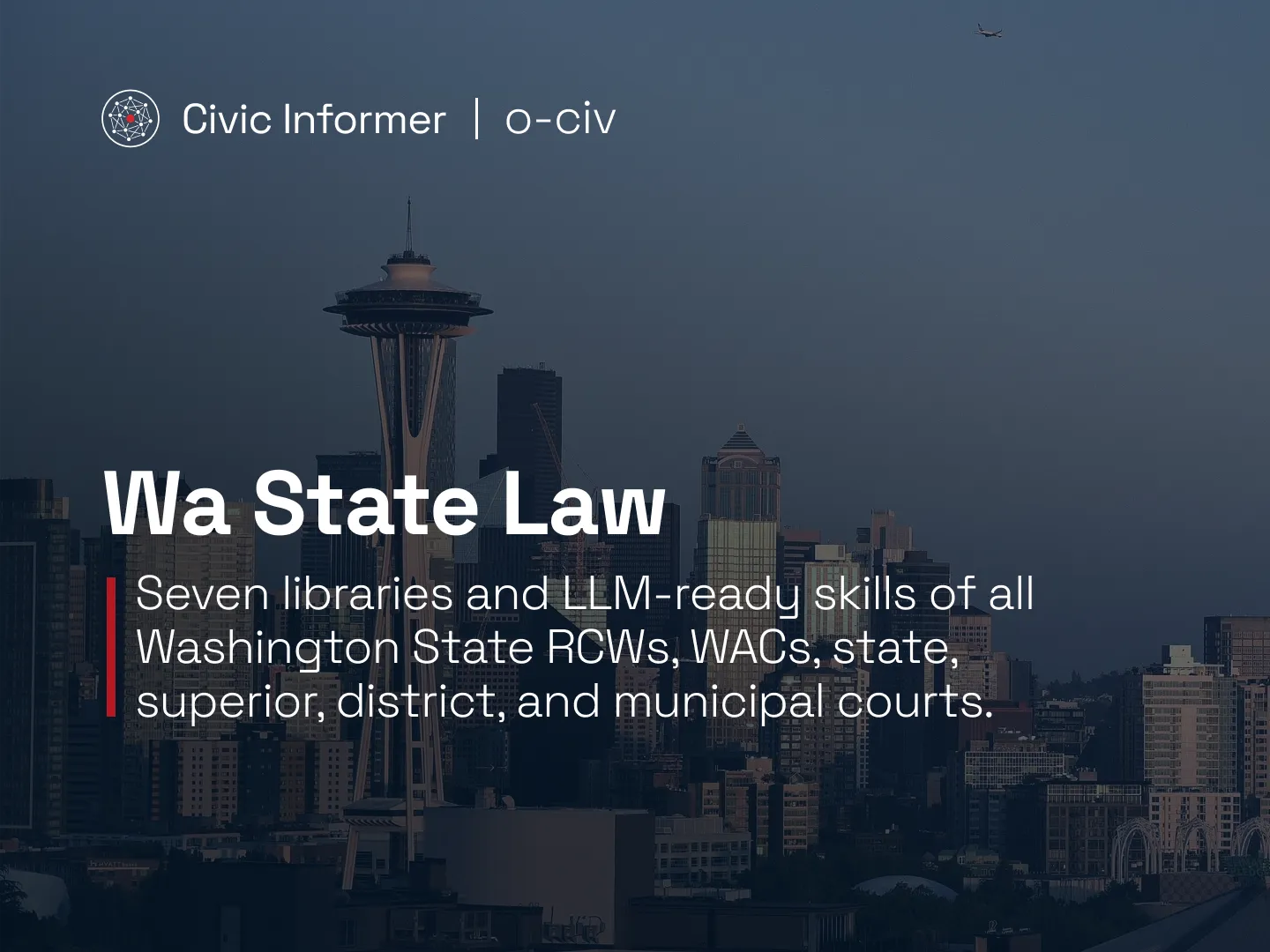
Washington state law: open-source archive & AI skills
View post ›To the residents, and to the institutions
If you live in one of the communities we cover, this is built for you first. Read it. Share it with your neighbors. Tell us what is missing.
If you work at a city, county, agency, or department, we want to be a partner, not a critic. Most of the work that makes a community legible to its residents already happens inside your office. We are here to help it travel the last mile. If your data is hard to share, talk to us. We will meet you where you are.
A few ways to stay close to the work:
- Find your city to see what is live today.
- Follow along on X and LinkedIn for releases and behind-the-scenes notes.
- Read more on the blog.
Want to get involved? Whether you are a city, a journalist, a researcher, or a developer, we want to hear from you. Reach out.